Category: Uncategorized

  • The Metal Matters Too: Choosing Corrosion-Resistant Hardware for Floating Keychains

    The Metal Matters Too: Choosing Corrosion-Resistant Hardware for Floating Keychains

    Almost every conversation about floating keychains is about the float: the foam, the cork, the buoyancy that keeps a set of keys at the surface instead of on the seabed. But walk any marina at the end of a season and the parts that have failed are rarely the foam. They are the metal. A split ring that has bloomed with rust, a snap hook seized half-open, a jump ring that has worn thin and let a fob drop. On the water, the hardware is usually the weak link, and it is the part buyers think least about when they place an order.

    This is a look at the metal fittings on a custom floating keychain, why cheaper hardware fails in salt air, and how to specify fittings that outlast the print.

    Why the ring rusts before the float fails

    A floating keychain lives in about the harshest environment a small metal part can face: repeated wetting with salt water, then drying in air, over and over. That wet-dry cycling in the presence of chloride is what drives corrosion, and it concentrates in exactly the places hardware has crevices, under the coils of a split ring, inside a snap hook’s spring, at the seam of a jump ring. Foam and cork are chemically indifferent to salt, so they keep floating long after an inexpensive ring has rusted through. The float is doing its job; the metal is quietly failing. Which metal you put on the keychain therefore decides its real service life far more than the color of the foam does.

    The two stainless grades, and why the number matters

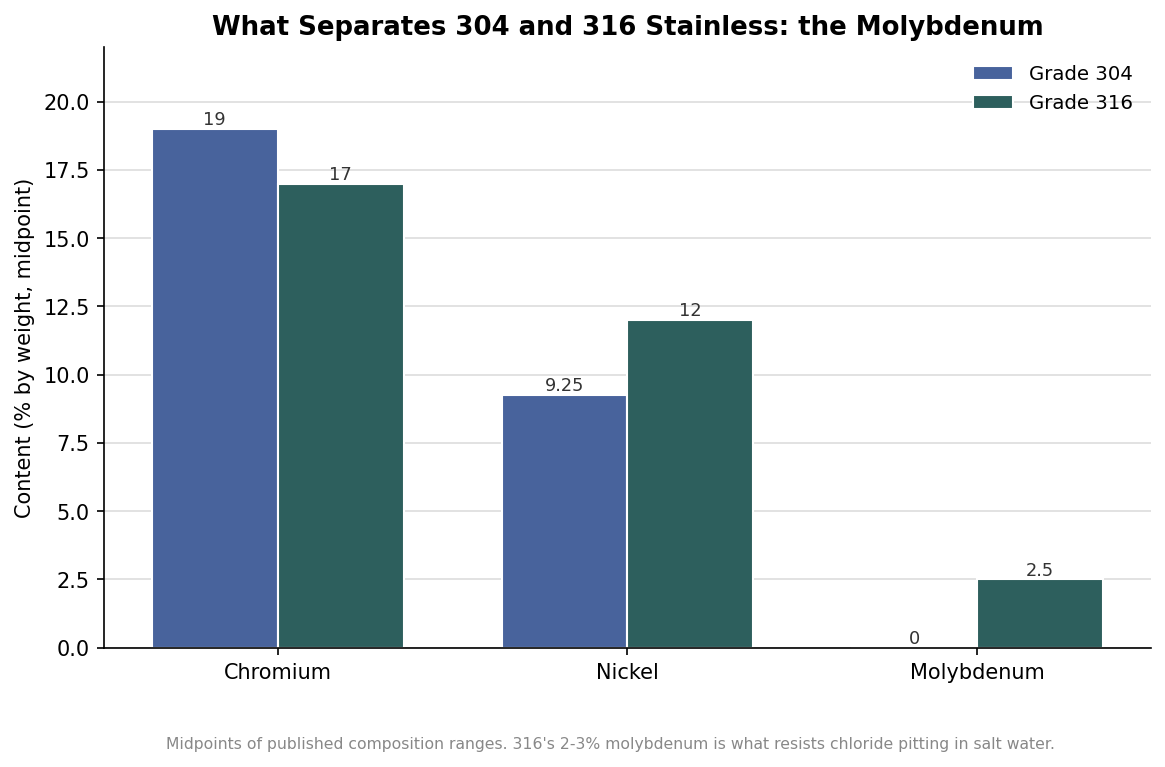
    When a supplier says a fitting is “stainless,” the useful question is which grade. The two you will actually be quoted are 304 and 316, and the difference between them is specific and measurable. The operative element is molybdenum. Grade 304 contains essentially none; grade 316 contains roughly 2 to 3 percent, along with a higher nickel content of about 10 to 14 percent versus 8 to 10.5 percent in 304. That molybdenum stabilizes the thin chromium-oxide film that protects the steel, specifically against the chloride attack that seawater delivers.

    The shorthand for this is the Pitting Resistance Equivalent Number, or PREN. Grade 304 sits around 18 to 20; grade 316 sits around 24 to 26. That gap shows up in the field: 304 hardware in direct salt exposure typically begins to show pitting within one to three seasons, starting in the crevices and splash zones, while 316 holds up markedly longer in the same conditions. For anything that will see spray or immersion, 316 (and 316L, the low-carbon version used where parts are welded) is the grade worth paying for. Grade 304 is genuinely fine for a keychain that lives inland or only occasionally meets water, but it is the wrong economy for a dive shop or a marina.
    Grouped bar chart comparing chromium, nickel, and molybdenum content of 304 and 316 stainless steel
    Grade 316 adds 2-3% molybdenum and more nickel, which is what resists chloride corrosion in salt water.

    The cheaper metals you will be offered

    Most bargain keychain hardware is not stainless at all. It is nickel-plated zinc alloy or nickel-plated steel, chosen because it is inexpensive and looks bright and clean in a photo. The problem is that the corrosion resistance is only skin deep. The nickel plating is a thin shell over a base metal that rusts readily, and on a keychain that plating is under constant mechanical abrasion, keys rubbing, the ring flexing every time it goes on and off a belt loop. Once the plating wears through at a high-friction spot, salt water reaches the zinc or steel underneath and it corrodes quickly, often within weeks of real marine use. Zinc’s corrosion shows up as a chalky white bloom before it pits; plated steel simply rusts.

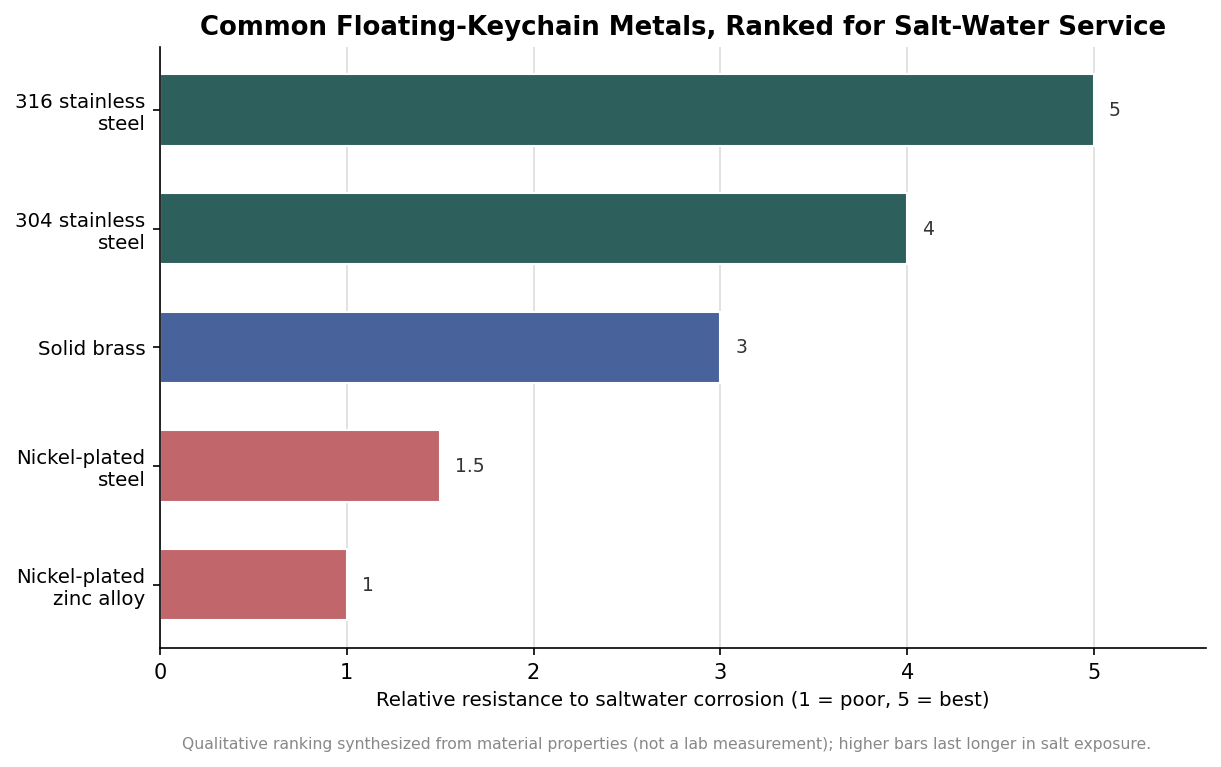
    Solid brass is a step up and a reasonable middle option: it does not rust because it contains no iron, and it resists salt water far better than plated base metal, though it will tarnish to a duller finish over time and is softer than stainless. The honest ranking, from a floating keychain’s point of view, runs from nickel-plated zinc and steel at the bottom, through brass in the middle, up to 304 and then 316 stainless at the top.
    Horizontal bar chart ranking keychain metals by relative saltwater corrosion resistance
    A relative ranking of common floating-keychain metals for salt-water service, from plated base metal up to 316 stainless.

    Ring gauge and how the fob attaches

    Grade is not the whole story; the ring’s build matters too. A split ring’s wire gauge determines how much it resists being pried open by a heavy bunch of keys, and a double-loop split ring holds a fob far more securely than a single thin jump ring, which can fatigue and spring open. Where a snap hook or bolt clip is used for quick detachment, that spring mechanism is both the convenience and the vulnerability, because it is the first place salt tends to seize the moving part. It is worth asking how the metal fitting attaches to the float as well: a ring threaded through a molded, reinforced hole in the foam lasts longer than one pinched through a thin slit that can tear.

    Specifying hardware on your order

    The single most useful thing a buyer can do is refuse to accept “stainless” as a complete answer and ask for the grade in writing, 304 or 316, with 316 specified for any product that will be sold or given away around salt water. It is worth being explicit that plated zinc or steel is not acceptable for a marine product, even as a cost-saving substitution, because a rusted keychain reflects on the brand printed across it. Where budget forces a compromise, brass hardware on the ring is a far safer economy than plated base metal. And because photos of new hardware all look equally shiny, the only real proof is time or a salt-spray test, so it is reasonable to ask a supplier what their hardware is rated to withstand before you commit a large run to it.

    The foam is what makes a floating keychain float. The metal is what makes it last. Spend the small premium on the fitting, name the grade on the order, and the keychain will still be carrying a clean logo long after the cheaper version has rusted into a giveaway nobody wants to be seen using.
  • How to Print a Logo on a Floating Keychain: Pad Print, Screen Print, Dome Label, and Deboss Compared

    How to Print a Logo on a Floating Keychain: Pad Print, Screen Print, Dome Label, and Deboss Compared

    Every floating keychain starts as a piece of foam, and that foam is the whole reason the decoration question is harder than it looks. Unlike hard acrylic or metal, EVA and polyurethane foam is soft, slightly textured, and often dark, so the method you use to put a logo on it changes how crisp the artwork looks, how many colors you can run, and how long the branding survives in salt water and sun. The four methods below cover almost everything a supplier will quote, and each one suits a different kind of logo and budget.

    Pad printing: the default for foam

    Pad printing is what most floating keychains actually use. A silicone pad picks ink up from an etched plate and presses it onto the foam, and because the pad flexes it handles the soft, slightly uneven surface that would defeat a flat screen. On a common rectangular float of about 3.15 by 1.38 inches, the usable imprint area lands near 2 inches wide by 0.75 inch tall, which is enough for a boxy logo and a short line of text but not much more. Pad printing runs one or two colors comfortably and carries a modest one-time setup charge, often in the range of $40 to $45, plus a small per-color fee if you exceed a single ink. If your mark is a solid one- or two-color logo and you want the lowest unit cost, this is almost always the answer.

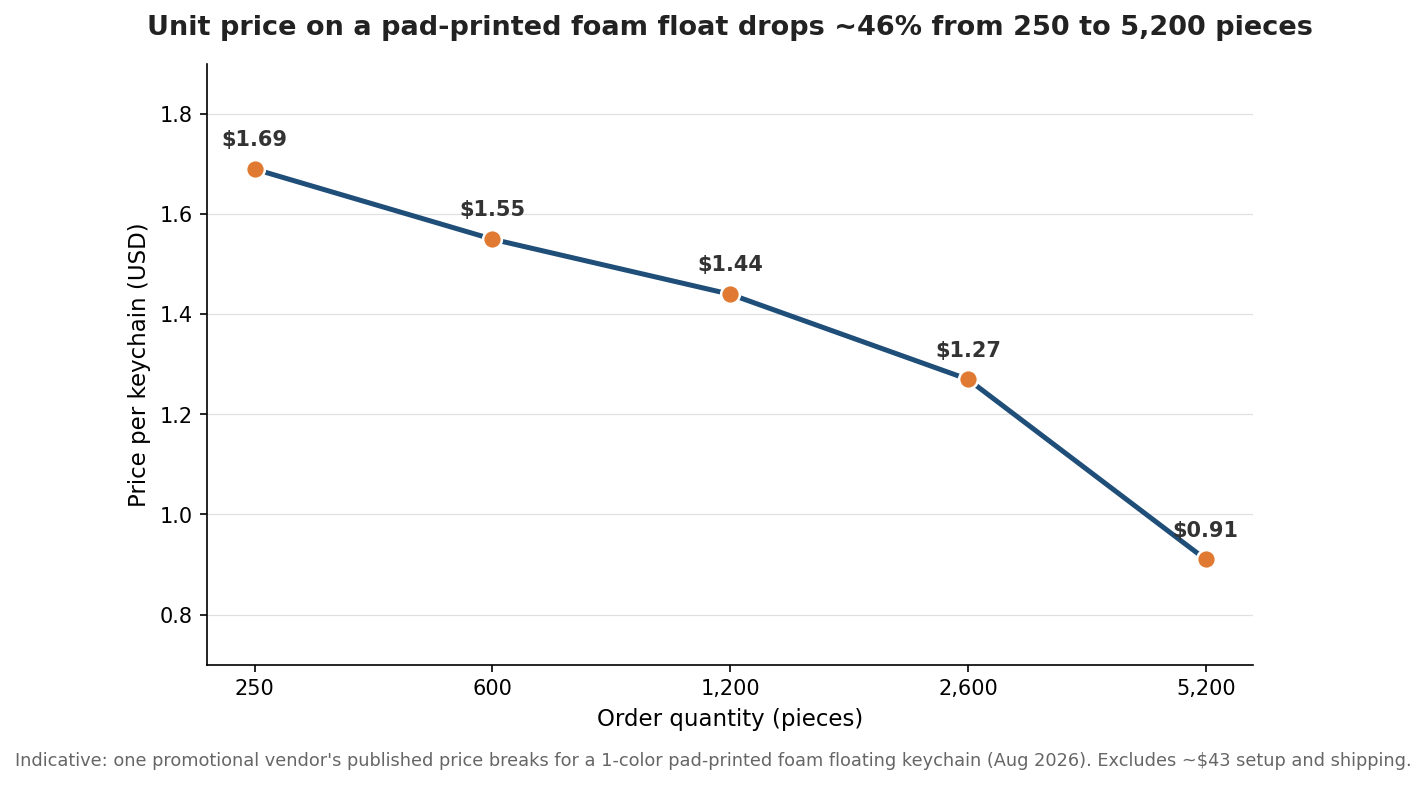
    Line chart of per-unit price for a pad-printed foam floating keychain falling from $1.69 at 250 pieces to $0.91 at 5,200 pieces
    Per-keychain price drops steeply as order quantity rises, based on one vendor’s published price breaks.

    Screen printing and multi-color logos

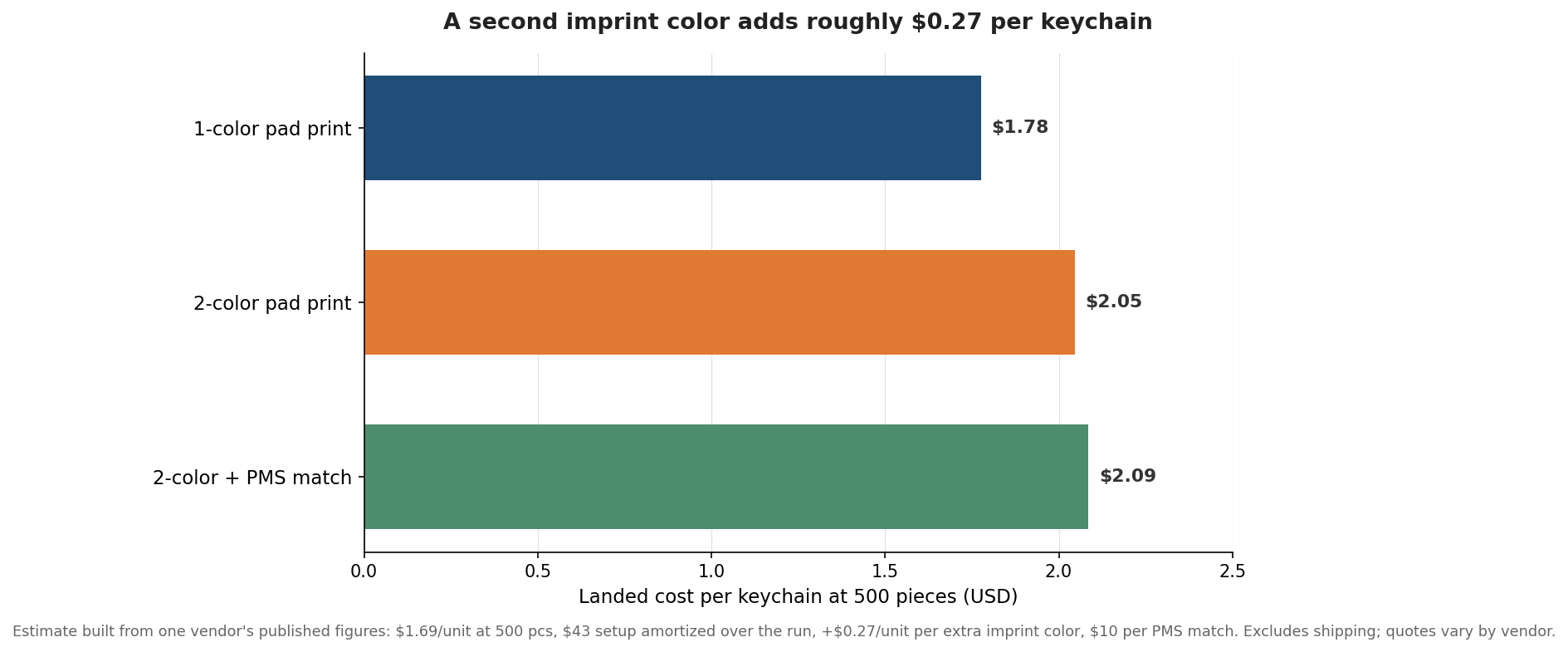
    Screen printing lays down a thicker, more opaque ink film, which matters when you are putting a light logo on a dark foam. It is well suited to bold, solid shapes and typically tops out around three spot colors on a keychain-sized surface. The practical limit to watch is small type: on darker foam, most decorators ask for a minimum text height around 4 millimeters so fine lettering does not fill in or disappear. Screen printing and pad printing overlap heavily at this size, and many suppliers will quietly choose whichever fits their equipment, so the more useful decision for you is how many colors your logo truly needs rather than the press itself. Each additional spot color adds both a setup step and a per-unit charge, commonly around $0.27 per piece for the extra color, and a matched brand color under the Pantone system usually adds a flat fee near $10 per color.

    Dome labels and full-color decoration

    When the logo has gradients, a photo, or more colors than a spot process can handle, the answer is a full-color label, often finished with a clear epoxy dome. The artwork is printed digitally on a substrate, applied to the foam, and then coated so it sits under a glossy, water-resistant bubble. Doming solves two problems at once: it removes the color ceiling entirely, and the cured resin shrugs off water and abrasion better than a bare printed surface. The trade-offs are cost and feel. A domed label adds material and labor over a simple pad print, and it introduces a hard, raised element onto an otherwise soft keychain, which some buyers like and others do not. For a complex, multi-color brand mark that has to look exactly right, though, it is usually the only method that reproduces the art faithfully.

    Debossing: ink-free and permanent

    Debossing presses your logo into the foam as a recessed impression with no ink at all. Because there is nothing printed to fade, chip, or wash off, a debossed mark is effectively permanent, and it reads as understated and premium rather than loud. The obvious limitation is that it is tone on tone: you get shape and texture, not color, so a logo that depends on color contrast will not translate. Debossing works best for simple, bold silhouettes and wordmarks where the outline alone is recognizable. It is worth considering for high-end marina or resort gifts where a subtle, tactile finish suits the brand better than a printed panel.

    Matching the method to your artwork and budget

    The cleanest way to choose is to start from the logo, not the price. A one- or two-color solid mark points to pad or screen printing; a gradient, photograph, or four-color logo points to a domed full-color label; and a premium, understated look with a simple silhouette points to debossing. Only after the method is set does volume drive the real number. Minimum orders on foam floats commonly sit between 250 and 500 pieces, unit prices for a simple print run from under a dollar at several thousand pieces up to roughly $1.69 at the smallest quantities, and lead times generally fall between about 13 and 26 days depending on how fast you need them. The chart below shows how a second imprint color and a Pantone match move the landed cost at a typical 500-piece run, so you can weigh whether the extra color earns its keep before you approve the art.

    Horizontal bar chart comparing landed cost per keychain at 500 pieces for one-color pad print, two-color pad print, and two-color with PMS match
    Each extra imprint color and Pantone match adds a small but real amount to the per-unit cost.

    Durability deserves a mention too, because a floating keychain lives a harder life than a desk giveaway. Salt water, sunscreen, sand, and constant UV all attack a printed surface, and the four methods hold up differently. A cured epoxy dome and a debossed impression are the most weatherproof because there is either a sealed coating or no ink to lose, while bare pad and screen prints are durable but will show wear sooner if the keychain is dragged across a dock every day. If the product is destined for a dive shop or a boat rental that hands out hundreds of these a season, that longevity difference is worth weighing against the lower upfront cost of a simple print.

    One last practical note: whatever method you pick, confirm the foam color against your ink early. Light artwork on dark foam is the single most common cause of a proof that looks weaker than expected, and it is far cheaper to adjust the color or bump the minimum text size at the art stage than to reprint a finished run.

  • Choosing Custom Floating Keychains by Use Case: Marinas, Rentals, and Dive Shops

    Choosing Custom Floating Keychains by Use Case: Marinas, Rentals, and Dive Shops

    The floating keychain that is right for a paddleboard rental is the wrong one for a dive shop, and both are wrong for a resort gift-shop giveaway. The float that works is decided less by the design you print on it and more by who is holding it, what is on the ring, and how the keys get lost in the first place. Before you pick a color or a shape, it helps to match the float to the job it actually has to do on the water.

    Start with the load, not the logo

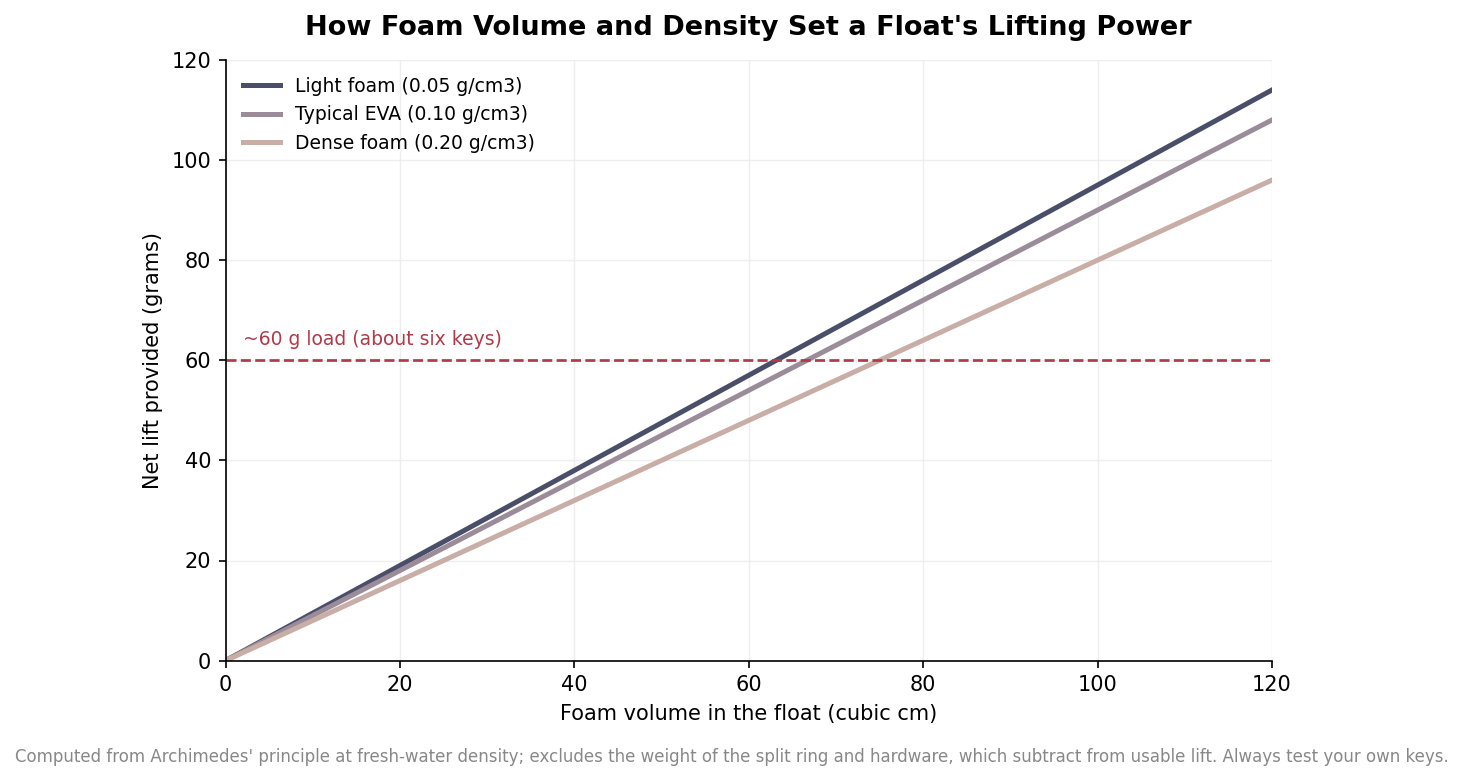
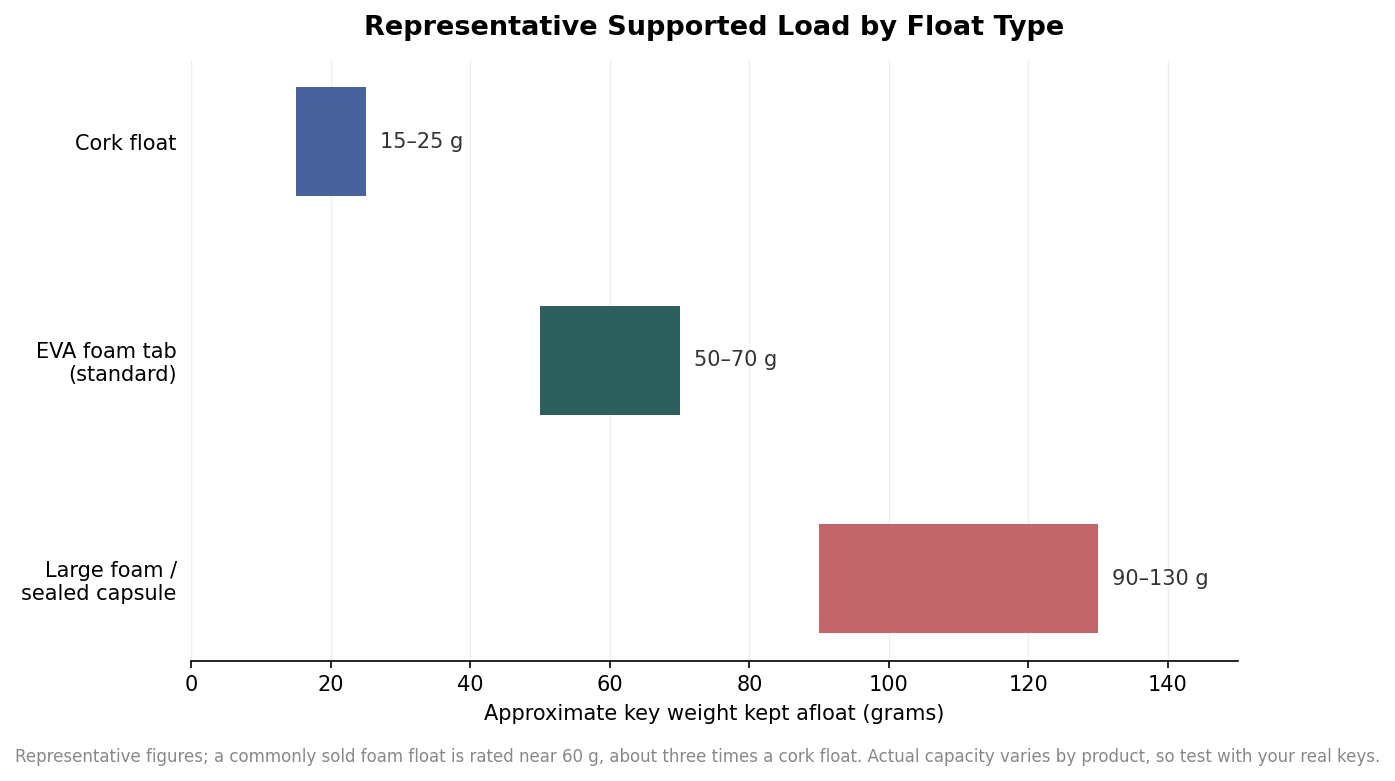
    A float only earns its name if it can carry the weight it is asked to hold. Foam does this because a closed-cell material such as EVA traps air and barely absorbs water, with a density somewhere between about 0.03 and 0.20 grams per cubic centimeter against water at roughly 1.0, so every cubic centimeter of foam provides close to a gram of lift. That sounds generous until you add up a real key ring. One commonly sold foam key float is rated to keep about 60 grams afloat, roughly six keys, which is about three times what a small cork float manages. A single brass boat key sits well inside that budget; a modern car fob with a metal transponder, or a ring loaded with a half-dozen keys and a bottle opener, can eat straight through it. The rule that survives every use case is to size the float to the heaviest ring you will actually hand out, and then to test that exact ring in a bucket of water before anyone trusts it in a lake.

    Line chart of net buoyant lift in grams versus foam volume for three foam densities, with a 60 gram load reference line
    Foam volume and density set how much weight a float can hold; hardware weight eats into it.

    Match the float style to the setting

    Once the load is covered, the setting decides the form. A marina or boat rental that hands over a single key on a ring is well served by a standard foam tab, which gives you a broad printable face and plenty of lift for a light load. A dive shop or fishing charter tends to put heavier, multi-key rings and gear keys in customers’ hands, which pushes you toward a larger foam body or a sealed buoyant capsule with more reserve lift. A jet-ski, kayak, or paddleboard rental lives and dies on quick retrieval in choppy water, so a bright, high-contrast float that a staffer can spot at a glance matters more than a large imprint. A waterfront resort or promotional giveaway is the one case where the branding surface leads, because the keychain is a marketing piece first and a safety device second, though it still needs enough foam to justify the word floating.

    Range bar chart of approximate key weight kept afloat by float type: cork, EVA foam tab, and large foam or sealed capsule
    Representative supported loads by float type; always test with your actual keys.

    A quick way to choose by business type

    If you want a shortcut, work backward from the customer interaction. Ask how heavy the typical ring is, whether the keys leave the dock in a customer’s pocket or stay clipped to a rental, and how far away a dropped float has to be spotted. A business that hands out light single keys can standardize on an economical foam tab and spend its budget on print quality. A business whose customers carry heavy or valuable keys should buy reserve buoyancy it will rarely need, because the one time a loaded ring goes overboard is the day the extra lift pays for the entire order. And a business giving the keychain away as a marketing item should optimize the branding surface but still confirm the float holds at least a single key, so the product lives up to its own name in a customer’s hand.

    Color and retrieval are part of the spec

    On open water, floating is only half the job; being seen is the other half. A float can bob at the surface and still be nearly invisible against glare or chop if it is a muted color or too small to catch the eye. For any rental fleet, standardizing on a single high-visibility color such as safety orange or yellow does double duty, making a dropped set easy to spot and making the fleet’s keys instantly recognizable as belonging to the business. Size plays into this too: a slightly larger float is easier to see and easier to grab with cold hands, which is often worth more in practice than shaving a few cents off a smaller blank. Shape matters at the margins as well, since a long tab is easier to snatch from the water than a compact disc, and a reflective or printed stripe in a contrasting color adds a second visual cue when the base color washes out under bright sun.

    Print, size, and the branding surface

    The last decisions are practical. Foam takes a printed logo well, but the usable imprint area is smaller than the float looks, and a busy, multi-color mark on a curved foam face reads worse than a bold, simple one. Decide early whether you need one-sided or two-sided printing, since a giveaway wants the brand facing out on both sides while a rental only needs its name legible. Where a supplier quotes minimum order quantities, lead times, or per-unit price breaks, treat those as indicative until the float style, size, and imprint are locked, because moving from a small foam tab to a larger sealed float changes both the tooling and the shipping weight. Settle the use case first, size the buoyancy to the real keys, then let color and print follow, and the keychain does its one job when a customer fumbles a ring over the side.

  • What Floating Keychains Are Made Of: EVA Foam, Cork, and the Physics of Staying Afloat

    What Floating Keychains Are Made Of: EVA Foam, Cork, and the Physics of Staying Afloat

    A floating keychain has exactly one job it cannot fail at, and it comes down to material science. Whether a keychain rides on the surface with your keys held clear of the water or slips quietly to the bottom of the lake is decided by what the float is made of and how much of it there is. Understanding the handful of materials used to build these things, and the simple physics that governs them, makes it easy to spot a float that will actually work from one that just looks the part.

    Why anything floats: density against water

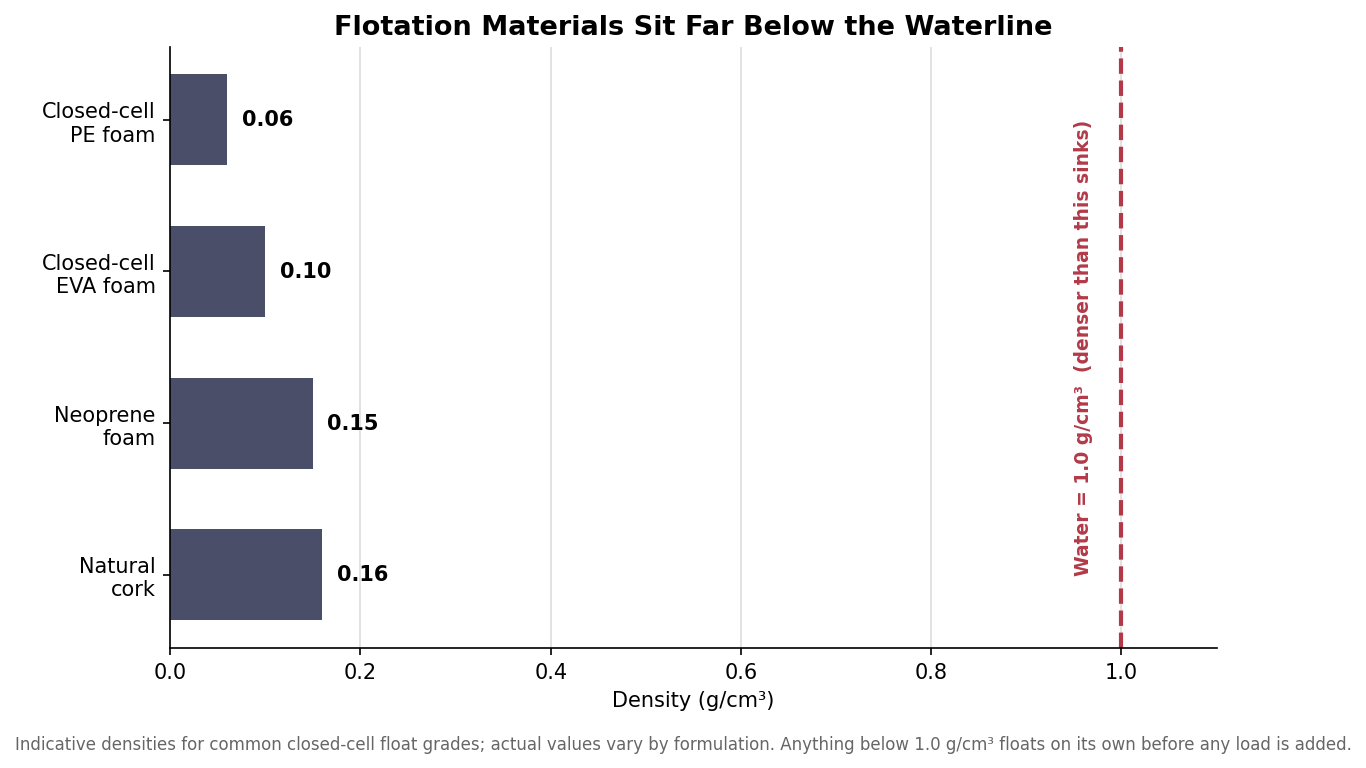
    Water has a density of about 1.0 gram per cubic centimeter. Any solid material less dense than that floats on its own, and anything denser sinks. That single number is the whole game. A float works because it is built from a material whose density is a fraction of water’s, which leaves a large margin of buoyancy to carry the dead weight of your keys and still stay on top. The materials used for keychain floats are not chosen for looks; they are chosen because they sit far below the waterline with room to spare.

    Horizontal bar chart of flotation material densities against the 1.0 g/cm3 waterline: PE foam 0.06, EVA foam 0.10, neoprene 0.15, cork 0.16
    Common float materials all sit far below water’s density, so they float before any keys are added.

    The common flotation materials all cluster at the light end of the scale. Closed-cell polyethylene foam runs around 0.06 grams per cubic centimeter in light grades; closed-cell EVA foam, the workhorse of promotional floats, sits in the neighborhood of 0.05 to 0.15 depending on formulation; neoprene foam is a bit heavier at roughly 0.15; and natural cork typically falls between 0.12 and 0.20. Every one of these is well under 1.0, which is exactly why they float before you add a thing. The values here are indicative ranges, since each material comes in many grades, but the pattern holds: these are all featherweight relative to water.

    Closed-cell is the phrase that matters

    The most important word in any float spec is closed-cell. In a closed-cell foam, the gas pockets are sealed off from one another, so water cannot wick into the body of the material. That is what keeps buoyancy constant over time. An open-cell foam, the kind used in a kitchen sponge or a cheap cushion, has interconnected pores that drink water, gain weight, and lose their float within minutes of submersion. A quality EVA float sheet absorbs almost nothing even under pressure; published specs for closed-cell EVA list water absorption on the order of a few hundredths of a pound per square foot at 100 psi, which is effectively nil for keychain use. A float that goes soggy and heavy after a season in the water was almost certainly built from the wrong cell structure.

    This is also why foam-filled hollow floats and solid closed-cell foam bodies behave so differently from a hollow plastic shell. A sealed hollow shell floats beautifully until the seam cracks or the cap loosens, at which point it fills and sinks. A solid closed-cell foam body has no cavity to flood; nick it, cut it, or drill it for a split ring and the rest of the material keeps right on floating.

    How much weight a float can actually hold

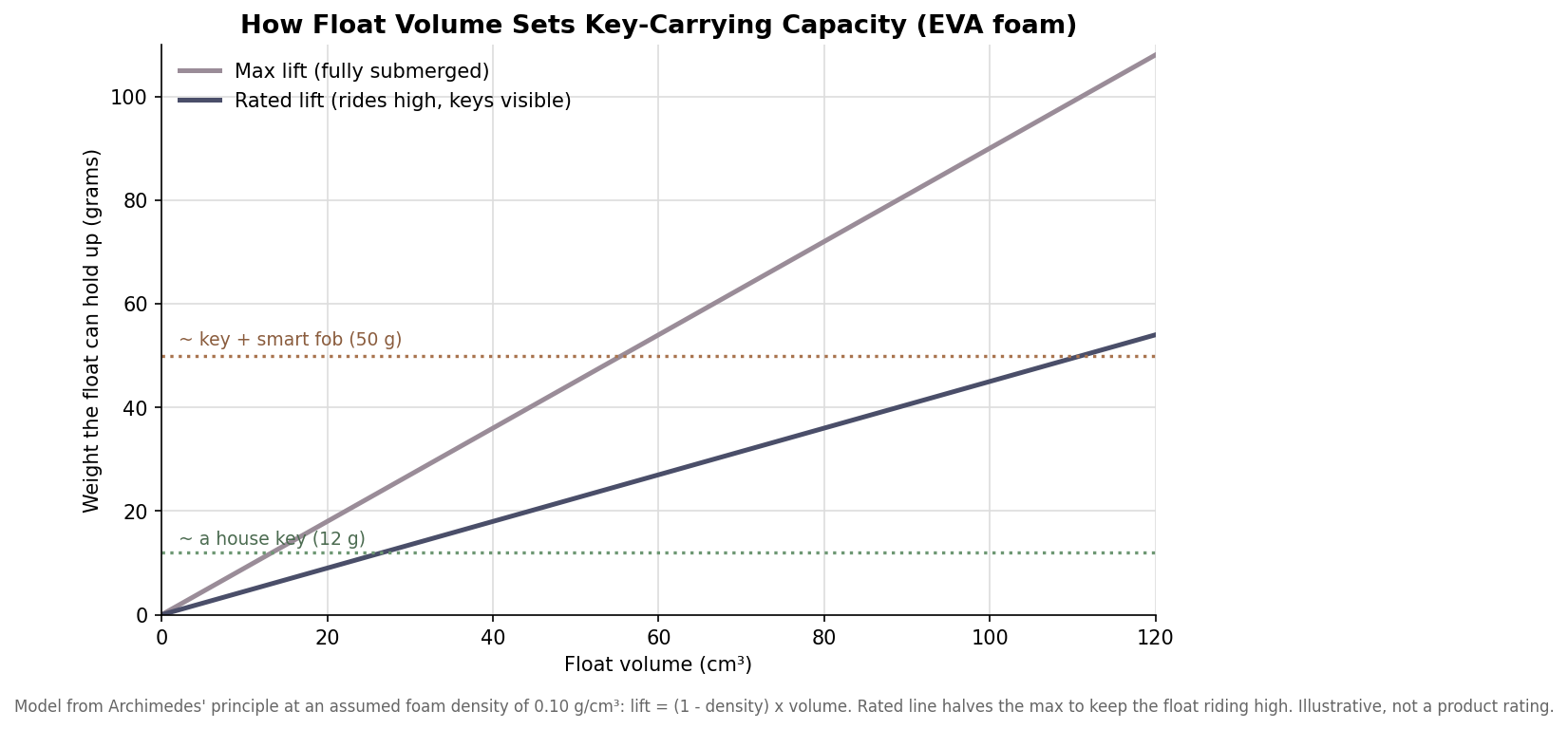
    Buoyancy is not just about floating an empty keychain; it is about floating the keychain plus your keys. The physics is Archimedes’ principle: the upward force equals the weight of the water the float pushes aside. For a solid foam float, the most extra weight it can support, right at the point of being fully submerged, is roughly its volume multiplied by the difference between water’s density and the foam’s. A 40-cubic-centimeter EVA float at a density near 0.10 weighs about 4 grams itself and could in theory hold up around 36 grams before it goes under.

    Line chart of weight a float can support versus float volume for EVA foam, with reference lines for a 12-gram house key and a 50-gram key-plus-fob
    Carrying capacity rises with float volume; the rated line keeps the float riding high with keys visible.

    In practice you never want to run a float at that limit, because a float sitting flush with the surface is one wave away from sinking and keeps your keys wet. A sensible working rule is to rate a float at about half its theoretical maximum so it rides high with visible freeboard. That reserve is what keeps the keys up out of the water and the bright color showing. Set against real loads, a typical brass house key weighs on the order of 10 to 15 grams, while a modern car key with an electronic smart fob can run 30 to 60 grams or more. So a small foam float easily carries a house key or two, but a heavy key-and-fob bundle needs a noticeably larger body, which is why floats sized for boaters and marinas are chunkier than a simple keyring bob. The lesson for anyone speccing a custom float is to size the volume to the heaviest keyset it will realistically carry, not the lightest.

    Choosing a material for a custom float

    For most branded and promotional work, closed-cell EVA foam is the default for good reason: it is light, genuinely waterproof, takes bright pigments and printing well, and is soft enough to be comfortable in a pocket while rigid enough to hold a shape and a logo. Polyethylene foam is even lighter and very tough, favored where maximum buoyancy per gram matters. Neoprene brings a soft, grippy, wetsuit-like feel and shrugs off sun and salt, which suits marine and dive markets. Cork is the natural, sustainable choice with a distinctive look, though it is the densest of the group and benefits from a sealed finish to stay looking clean.

    None of these will fail the float test if they are genuinely closed-cell and sized correctly for the load. The failures come from the wrong cell structure, a hollow shell that can flood, or a body too small for the keys it has to carry. Get the material and the volume right and the physics does the rest, keeping your keys on the surface and in sight where a dropped set can be scooped up rather than lost. Match the foam to the use, size it to the heaviest realistic keyset, and confirm the float rides high with a real bundle of keys before committing to a production run.

  • Why Your Floating Keychain Sank

    A floating keychain that went under was usually working exactly as built. It was specified as a bare fob and then carried as a loaded assembly.

    Cause one: the payload was never calculated

    The fob floats. The fob plus a house key, a car fob and an opener does not.

    Modern car fobs are heavy, and they are the single most common cause.

    Cause two: the material drank

    Open-cell foam and unsealed cork take on water across a season of real use.

    The fob rides lower each month until its payload falls below the keys it holds.

    The quiet third cause

    A punctured hollow body fills and sinks, and looks identical to a working float first.

    Foam cannot fail that way, which is why foam is often the right answer for pockets.

    What to ask before you order

    The payload in grams, net of any coil, clip or opener you are adding.

    The material, and for hollow bodies the wall thickness and how the seam is made.

  • Floating Is Half the Job. Being Found Is the Other Half.

    Recovery is a visibility problem as much as a buoyancy one, and it is decided before anything is moulded.

    Orientation first

    Ring weight low, volume high, and the fob self-rights with a face to the sky.

    Get that wrong and the brightest colour on the market is pointing underwater.

    Fluorescent for daylight

    Orange and yellow-green are the two that hold up at distance in daylight.

    They read against open water and against a dark hull, which most colours do not.

    Reflective for a beam

    Reflective returns light to its source, so it needs a torch to do anything.

    At dusk it is transformative. At noon it is decoration.

    Size the visible face, not the fob

    A large fob with a small printed face is not a visible fob.

    We put the high-visibility colour on the upward face and keep the mark out of its way.

  • The Complete Buyer’s Guide to Custom Floating Keychains

    Floating keychains are compared on size, colour and price. None of the four questions below is about any of those.

    How much key weight will it hold?

    Net buoyancy is displacement minus everything on the ring, and a car fob is heavy.

    Ask for a payload in grams. A supplier who only offers the word floating has not done the sum.

    Does the material absorb?

    Closed-cell EVA does not. Open-cell foam and unsealed cork do, gradually.

    A sealed hollow body does not either — until a puncture makes it a sinker.

    Which way up does it sit?

    Weight low and volume high makes a fob self-right under load.

    A flat symmetrical slab rides edge-on and disappears in chop.

    Is it attached to anybody?

    Over moving water, a wrist coil or clip is the plan and the float is the backup.

    Remember the coil’s own mass comes off the payload.

    Then choose the colour

    Fluorescent orange or yellow-green for daylight, reflective for a torch.

  • Hello world!

    Welcome to WordPress. This is your first post. Edit or delete it, then start writing!