Almost every conversation about floating keychains is about the float: the foam, the cork, the buoyancy that keeps a set of keys at the surface instead of on the seabed. But walk any marina at the end of a season and the parts that have failed are rarely the foam. They are the metal. A split ring that has bloomed with rust, a snap hook seized half-open, a jump ring that has worn thin and let a fob drop. On the water, the hardware is usually the weak link, and it is the part buyers think least about when they place an order.
This is a look at the metal fittings on a custom floating keychain, why cheaper hardware fails in salt air, and how to specify fittings that outlast the print.
Why the ring rusts before the float fails
A floating keychain lives in about the harshest environment a small metal part can face: repeated wetting with salt water, then drying in air, over and over. That wet-dry cycling in the presence of chloride is what drives corrosion, and it concentrates in exactly the places hardware has crevices, under the coils of a split ring, inside a snap hook’s spring, at the seam of a jump ring. Foam and cork are chemically indifferent to salt, so they keep floating long after an inexpensive ring has rusted through. The float is doing its job; the metal is quietly failing. Which metal you put on the keychain therefore decides its real service life far more than the color of the foam does.
The two stainless grades, and why the number matters
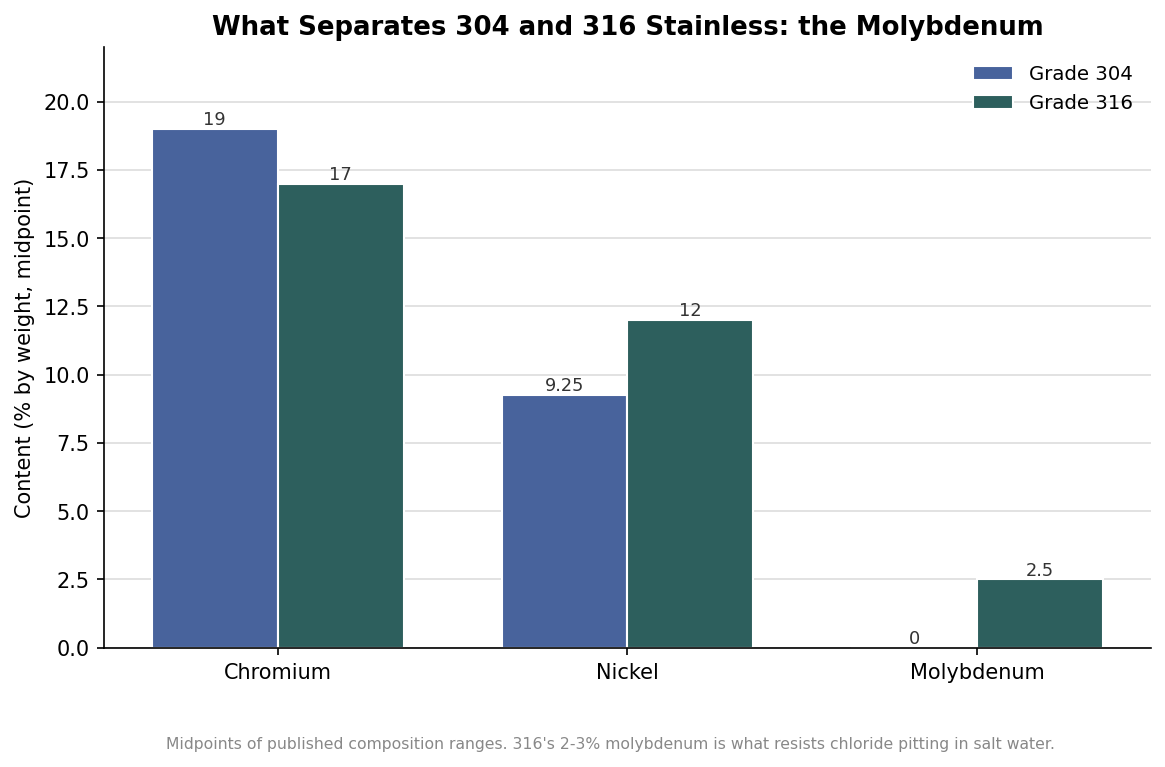
When a supplier says a fitting is “stainless,” the useful question is which grade. The two you will actually be quoted are 304 and 316, and the difference between them is specific and measurable. The operative element is molybdenum. Grade 304 contains essentially none; grade 316 contains roughly 2 to 3 percent, along with a higher nickel content of about 10 to 14 percent versus 8 to 10.5 percent in 304. That molybdenum stabilizes the thin chromium-oxide film that protects the steel, specifically against the chloride attack that seawater delivers.
The shorthand for this is the Pitting Resistance Equivalent Number, or PREN. Grade 304 sits around 18 to 20; grade 316 sits around 24 to 26. That gap shows up in the field: 304 hardware in direct salt exposure typically begins to show pitting within one to three seasons, starting in the crevices and splash zones, while 316 holds up markedly longer in the same conditions. For anything that will see spray or immersion, 316 (and 316L, the low-carbon version used where parts are welded) is the grade worth paying for. Grade 304 is genuinely fine for a keychain that lives inland or only occasionally meets water, but it is the wrong economy for a dive shop or a marina.
The cheaper metals you will be offered
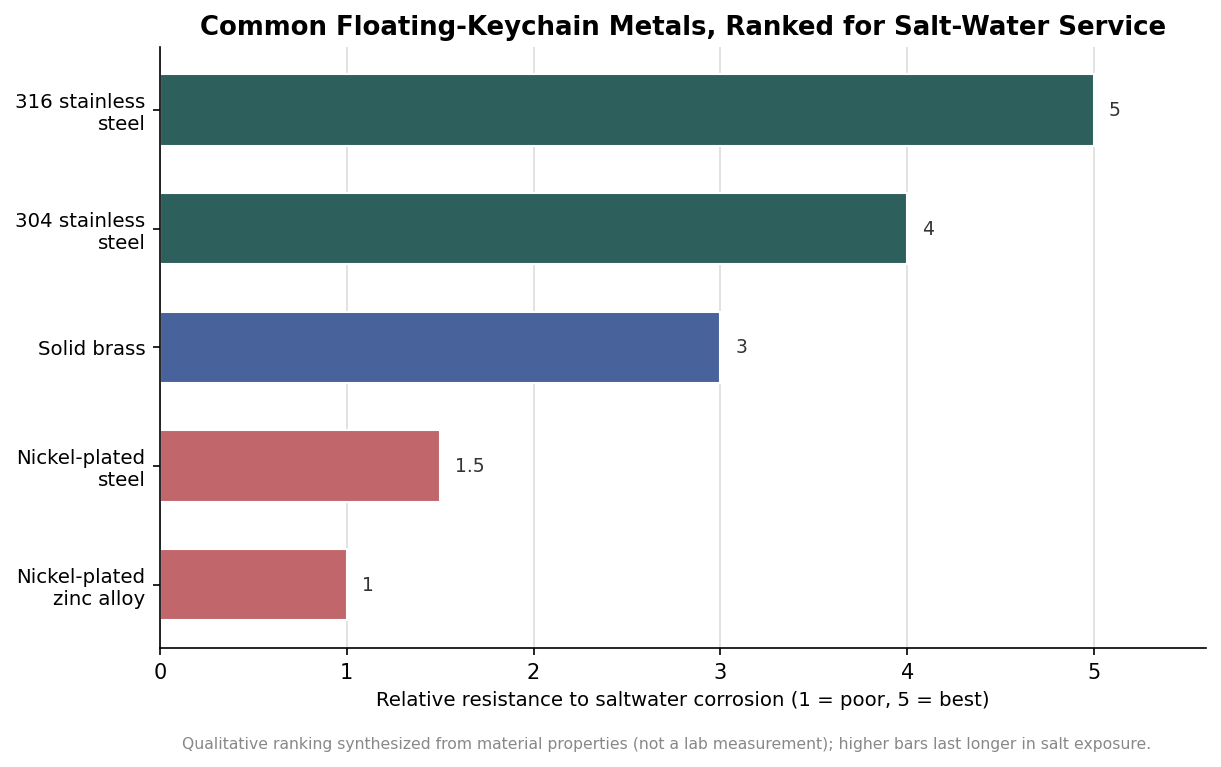
Most bargain keychain hardware is not stainless at all. It is nickel-plated zinc alloy or nickel-plated steel, chosen because it is inexpensive and looks bright and clean in a photo. The problem is that the corrosion resistance is only skin deep. The nickel plating is a thin shell over a base metal that rusts readily, and on a keychain that plating is under constant mechanical abrasion, keys rubbing, the ring flexing every time it goes on and off a belt loop. Once the plating wears through at a high-friction spot, salt water reaches the zinc or steel underneath and it corrodes quickly, often within weeks of real marine use. Zinc’s corrosion shows up as a chalky white bloom before it pits; plated steel simply rusts.
Solid brass is a step up and a reasonable middle option: it does not rust because it contains no iron, and it resists salt water far better than plated base metal, though it will tarnish to a duller finish over time and is softer than stainless. The honest ranking, from a floating keychain’s point of view, runs from nickel-plated zinc and steel at the bottom, through brass in the middle, up to 304 and then 316 stainless at the top.
Ring gauge and how the fob attaches
Grade is not the whole story; the ring’s build matters too. A split ring’s wire gauge determines how much it resists being pried open by a heavy bunch of keys, and a double-loop split ring holds a fob far more securely than a single thin jump ring, which can fatigue and spring open. Where a snap hook or bolt clip is used for quick detachment, that spring mechanism is both the convenience and the vulnerability, because it is the first place salt tends to seize the moving part. It is worth asking how the metal fitting attaches to the float as well: a ring threaded through a molded, reinforced hole in the foam lasts longer than one pinched through a thin slit that can tear.
Specifying hardware on your order
The single most useful thing a buyer can do is refuse to accept “stainless” as a complete answer and ask for the grade in writing, 304 or 316, with 316 specified for any product that will be sold or given away around salt water. It is worth being explicit that plated zinc or steel is not acceptable for a marine product, even as a cost-saving substitution, because a rusted keychain reflects on the brand printed across it. Where budget forces a compromise, brass hardware on the ring is a far safer economy than plated base metal. And because photos of new hardware all look equally shiny, the only real proof is time or a salt-spray test, so it is reasonable to ask a supplier what their hardware is rated to withstand before you commit a large run to it.
The foam is what makes a floating keychain float. The metal is what makes it last. Spend the small premium on the fitting, name the grade on the order, and the keychain will still be carrying a clean logo long after the cheaper version has rusted into a giveaway nobody wants to be seen using.