A floating keychain has exactly one job it cannot fail at, and it comes down to material science. Whether a keychain rides on the surface with your keys held clear of the water or slips quietly to the bottom of the lake is decided by what the float is made of and how much of it there is. Understanding the handful of materials used to build these things, and the simple physics that governs them, makes it easy to spot a float that will actually work from one that just looks the part.
Why anything floats: density against water
Water has a density of about 1.0 gram per cubic centimeter. Any solid material less dense than that floats on its own, and anything denser sinks. That single number is the whole game. A float works because it is built from a material whose density is a fraction of water’s, which leaves a large margin of buoyancy to carry the dead weight of your keys and still stay on top. The materials used for keychain floats are not chosen for looks; they are chosen because they sit far below the waterline with room to spare.
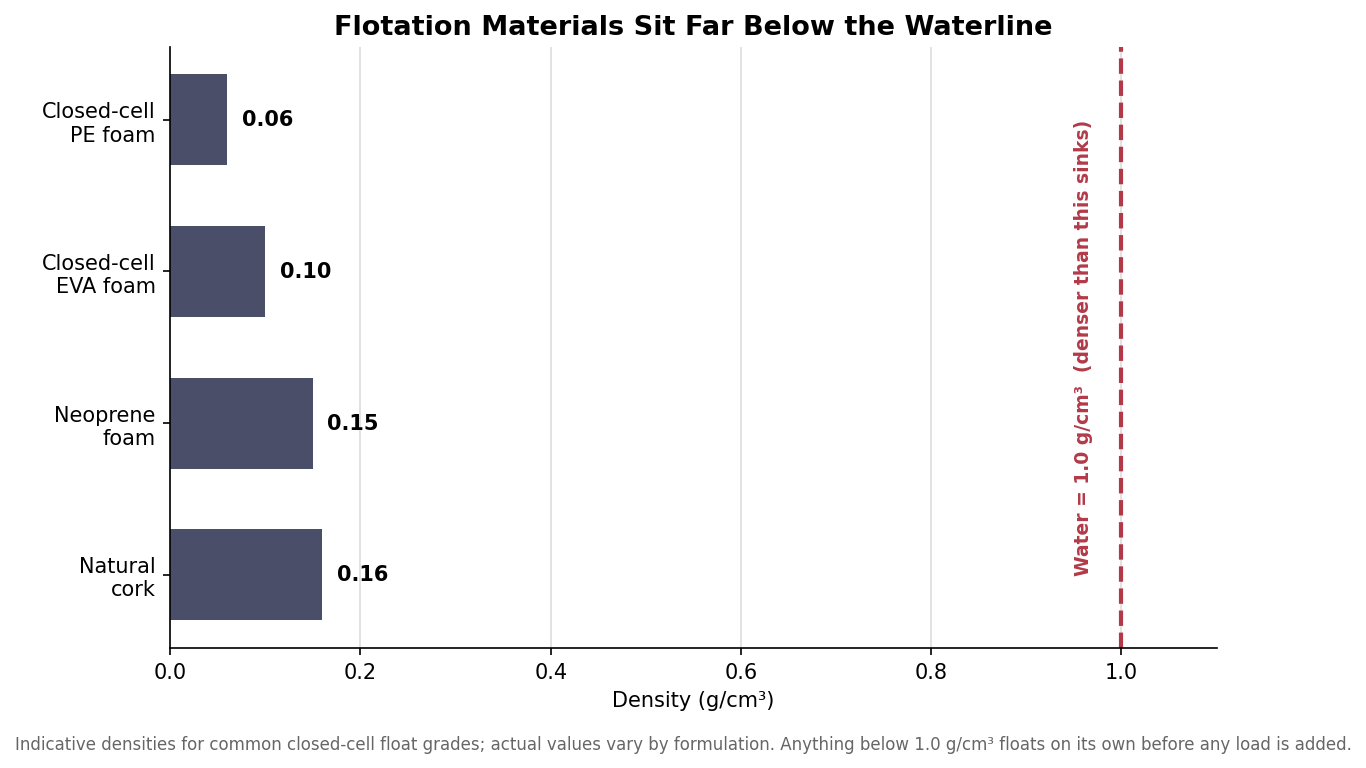
The common flotation materials all cluster at the light end of the scale. Closed-cell polyethylene foam runs around 0.06 grams per cubic centimeter in light grades; closed-cell EVA foam, the workhorse of promotional floats, sits in the neighborhood of 0.05 to 0.15 depending on formulation; neoprene foam is a bit heavier at roughly 0.15; and natural cork typically falls between 0.12 and 0.20. Every one of these is well under 1.0, which is exactly why they float before you add a thing. The values here are indicative ranges, since each material comes in many grades, but the pattern holds: these are all featherweight relative to water.
Closed-cell is the phrase that matters
The most important word in any float spec is closed-cell. In a closed-cell foam, the gas pockets are sealed off from one another, so water cannot wick into the body of the material. That is what keeps buoyancy constant over time. An open-cell foam, the kind used in a kitchen sponge or a cheap cushion, has interconnected pores that drink water, gain weight, and lose their float within minutes of submersion. A quality EVA float sheet absorbs almost nothing even under pressure; published specs for closed-cell EVA list water absorption on the order of a few hundredths of a pound per square foot at 100 psi, which is effectively nil for keychain use. A float that goes soggy and heavy after a season in the water was almost certainly built from the wrong cell structure.
This is also why foam-filled hollow floats and solid closed-cell foam bodies behave so differently from a hollow plastic shell. A sealed hollow shell floats beautifully until the seam cracks or the cap loosens, at which point it fills and sinks. A solid closed-cell foam body has no cavity to flood; nick it, cut it, or drill it for a split ring and the rest of the material keeps right on floating.
How much weight a float can actually hold
Buoyancy is not just about floating an empty keychain; it is about floating the keychain plus your keys. The physics is Archimedes’ principle: the upward force equals the weight of the water the float pushes aside. For a solid foam float, the most extra weight it can support, right at the point of being fully submerged, is roughly its volume multiplied by the difference between water’s density and the foam’s. A 40-cubic-centimeter EVA float at a density near 0.10 weighs about 4 grams itself and could in theory hold up around 36 grams before it goes under.
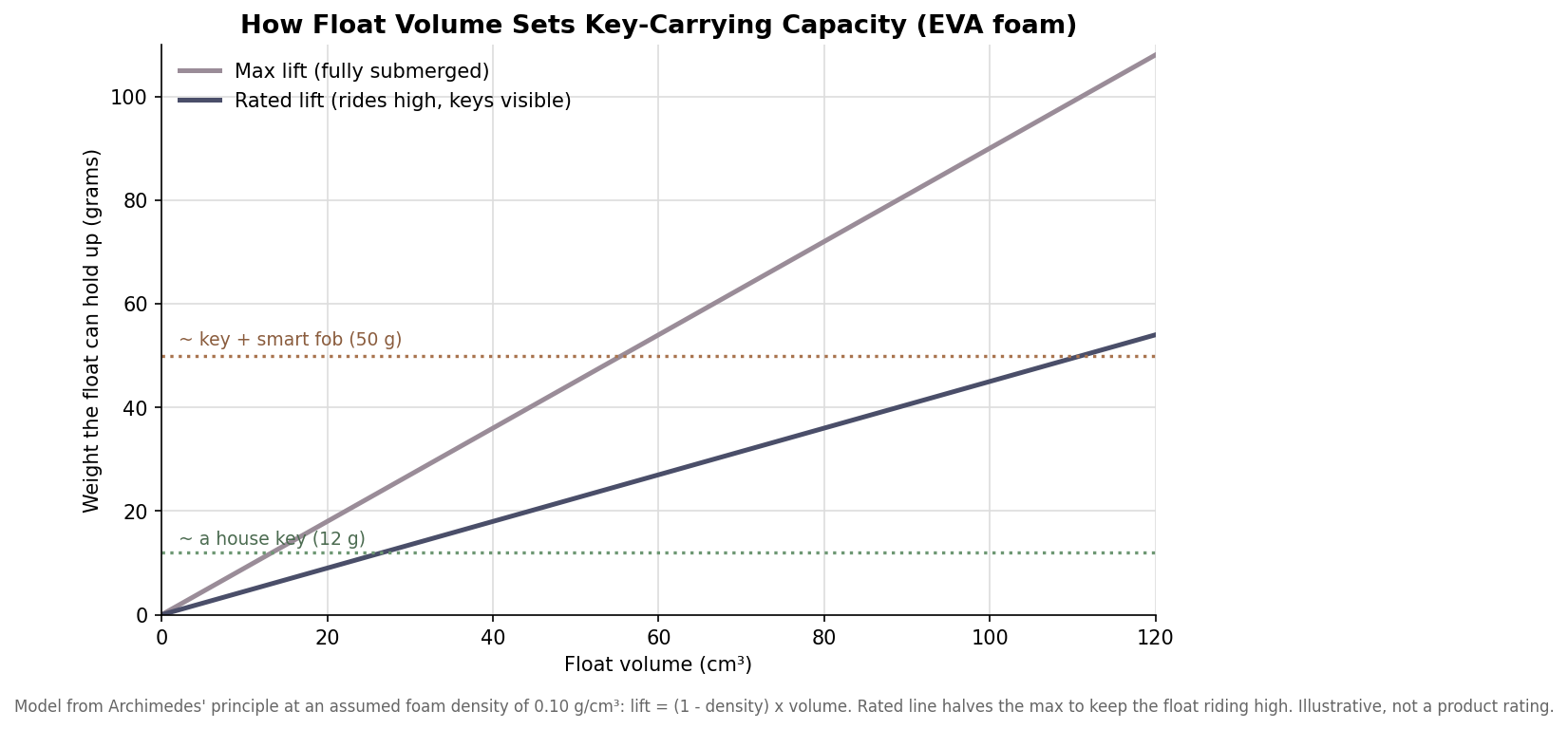
In practice you never want to run a float at that limit, because a float sitting flush with the surface is one wave away from sinking and keeps your keys wet. A sensible working rule is to rate a float at about half its theoretical maximum so it rides high with visible freeboard. That reserve is what keeps the keys up out of the water and the bright color showing. Set against real loads, a typical brass house key weighs on the order of 10 to 15 grams, while a modern car key with an electronic smart fob can run 30 to 60 grams or more. So a small foam float easily carries a house key or two, but a heavy key-and-fob bundle needs a noticeably larger body, which is why floats sized for boaters and marinas are chunkier than a simple keyring bob. The lesson for anyone speccing a custom float is to size the volume to the heaviest keyset it will realistically carry, not the lightest.
Choosing a material for a custom float
For most branded and promotional work, closed-cell EVA foam is the default for good reason: it is light, genuinely waterproof, takes bright pigments and printing well, and is soft enough to be comfortable in a pocket while rigid enough to hold a shape and a logo. Polyethylene foam is even lighter and very tough, favored where maximum buoyancy per gram matters. Neoprene brings a soft, grippy, wetsuit-like feel and shrugs off sun and salt, which suits marine and dive markets. Cork is the natural, sustainable choice with a distinctive look, though it is the densest of the group and benefits from a sealed finish to stay looking clean.
None of these will fail the float test if they are genuinely closed-cell and sized correctly for the load. The failures come from the wrong cell structure, a hollow shell that can flood, or a body too small for the keys it has to carry. Get the material and the volume right and the physics does the rest, keeping your keys on the surface and in sight where a dropped set can be scooped up rather than lost. Match the foam to the use, size it to the heaviest realistic keyset, and confirm the float rides high with a real bundle of keys before committing to a production run.