Every floating keychain starts as a piece of foam, and that foam is the whole reason the decoration question is harder than it looks. Unlike hard acrylic or metal, EVA and polyurethane foam is soft, slightly textured, and often dark, so the method you use to put a logo on it changes how crisp the artwork looks, how many colors you can run, and how long the branding survives in salt water and sun. The four methods below cover almost everything a supplier will quote, and each one suits a different kind of logo and budget.
Pad printing: the default for foam
Pad printing is what most floating keychains actually use. A silicone pad picks ink up from an etched plate and presses it onto the foam, and because the pad flexes it handles the soft, slightly uneven surface that would defeat a flat screen. On a common rectangular float of about 3.15 by 1.38 inches, the usable imprint area lands near 2 inches wide by 0.75 inch tall, which is enough for a boxy logo and a short line of text but not much more. Pad printing runs one or two colors comfortably and carries a modest one-time setup charge, often in the range of $40 to $45, plus a small per-color fee if you exceed a single ink. If your mark is a solid one- or two-color logo and you want the lowest unit cost, this is almost always the answer.
Screen printing and multi-color logos
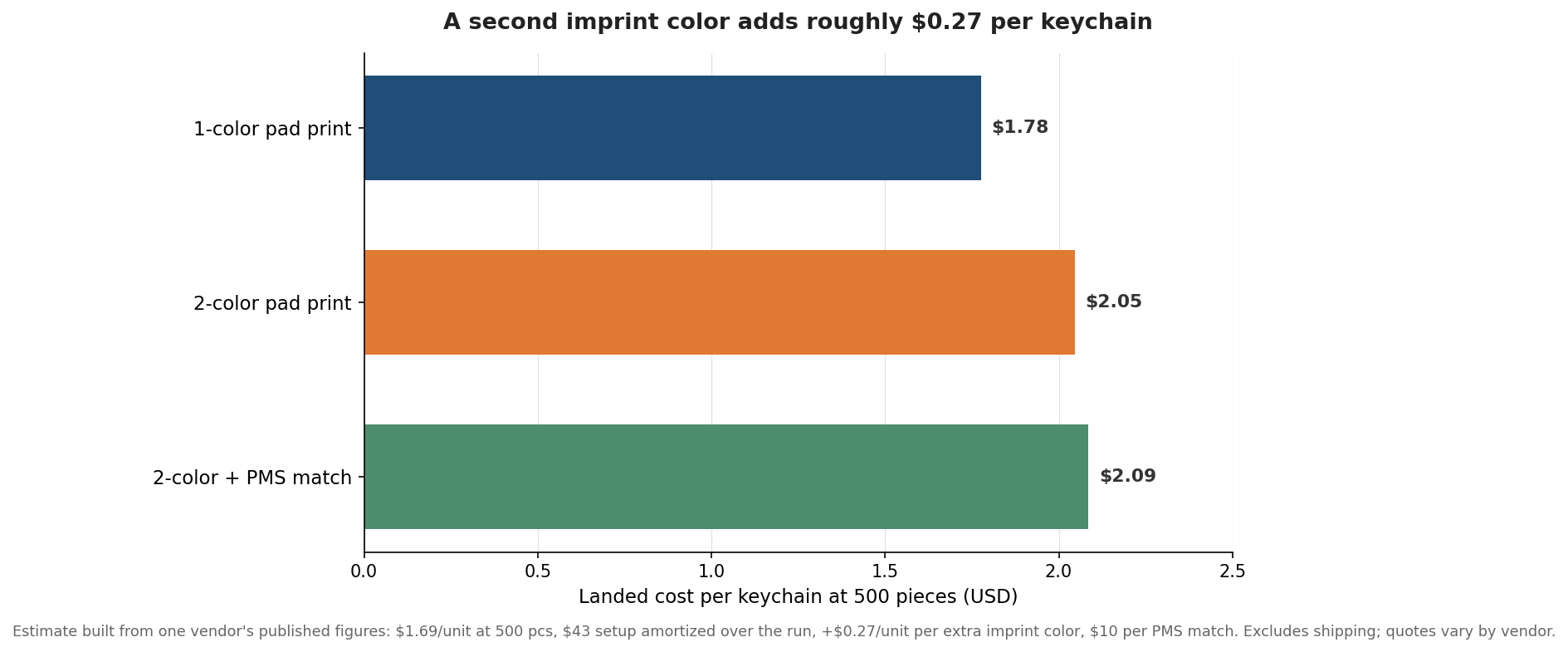
Screen printing lays down a thicker, more opaque ink film, which matters when you are putting a light logo on a dark foam. It is well suited to bold, solid shapes and typically tops out around three spot colors on a keychain-sized surface. The practical limit to watch is small type: on darker foam, most decorators ask for a minimum text height around 4 millimeters so fine lettering does not fill in or disappear. Screen printing and pad printing overlap heavily at this size, and many suppliers will quietly choose whichever fits their equipment, so the more useful decision for you is how many colors your logo truly needs rather than the press itself. Each additional spot color adds both a setup step and a per-unit charge, commonly around $0.27 per piece for the extra color, and a matched brand color under the Pantone system usually adds a flat fee near $10 per color.
Dome labels and full-color decoration
When the logo has gradients, a photo, or more colors than a spot process can handle, the answer is a full-color label, often finished with a clear epoxy dome. The artwork is printed digitally on a substrate, applied to the foam, and then coated so it sits under a glossy, water-resistant bubble. Doming solves two problems at once: it removes the color ceiling entirely, and the cured resin shrugs off water and abrasion better than a bare printed surface. The trade-offs are cost and feel. A domed label adds material and labor over a simple pad print, and it introduces a hard, raised element onto an otherwise soft keychain, which some buyers like and others do not. For a complex, multi-color brand mark that has to look exactly right, though, it is usually the only method that reproduces the art faithfully.
Debossing: ink-free and permanent
Debossing presses your logo into the foam as a recessed impression with no ink at all. Because there is nothing printed to fade, chip, or wash off, a debossed mark is effectively permanent, and it reads as understated and premium rather than loud. The obvious limitation is that it is tone on tone: you get shape and texture, not color, so a logo that depends on color contrast will not translate. Debossing works best for simple, bold silhouettes and wordmarks where the outline alone is recognizable. It is worth considering for high-end marina or resort gifts where a subtle, tactile finish suits the brand better than a printed panel.
Matching the method to your artwork and budget
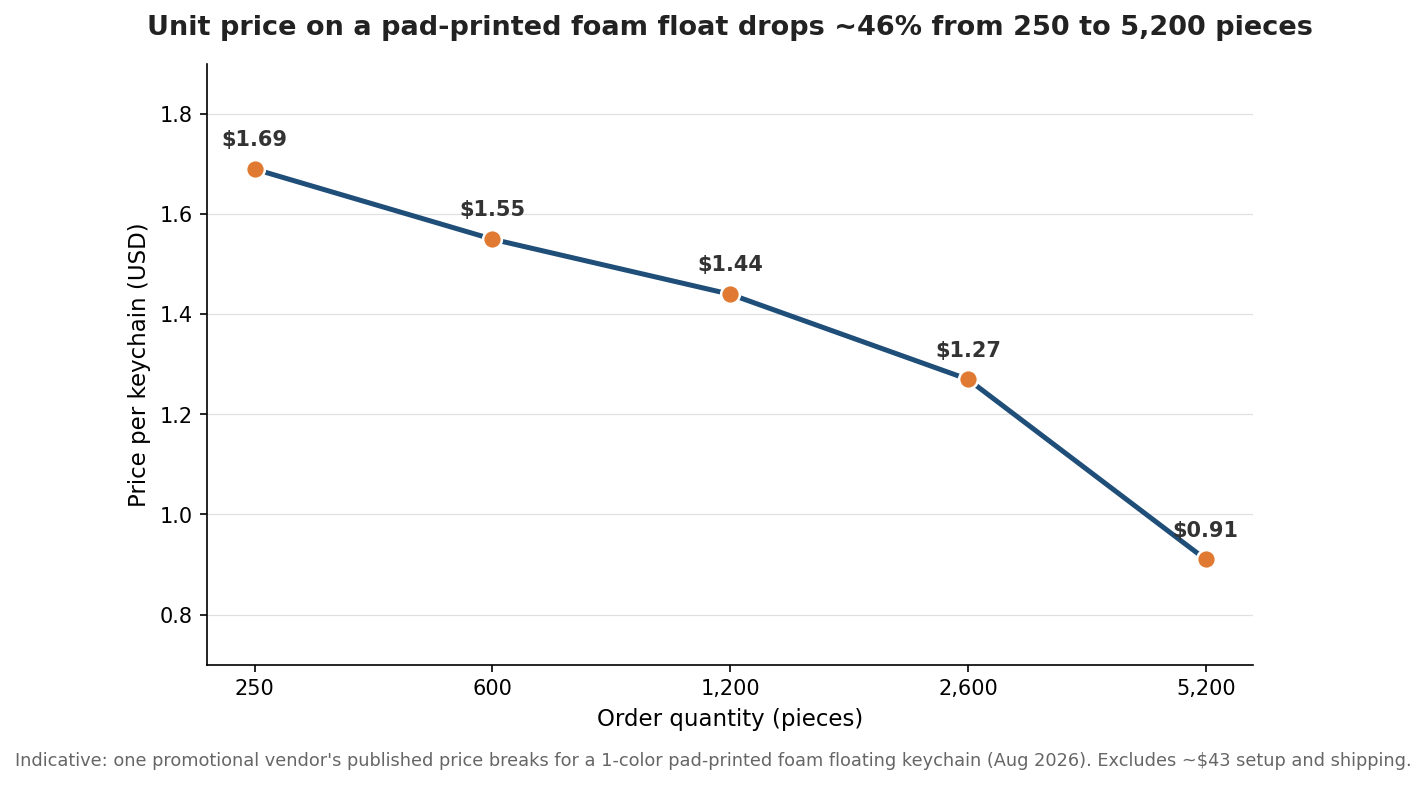
The cleanest way to choose is to start from the logo, not the price. A one- or two-color solid mark points to pad or screen printing; a gradient, photograph, or four-color logo points to a domed full-color label; and a premium, understated look with a simple silhouette points to debossing. Only after the method is set does volume drive the real number. Minimum orders on foam floats commonly sit between 250 and 500 pieces, unit prices for a simple print run from under a dollar at several thousand pieces up to roughly $1.69 at the smallest quantities, and lead times generally fall between about 13 and 26 days depending on how fast you need them. The chart below shows how a second imprint color and a Pantone match move the landed cost at a typical 500-piece run, so you can weigh whether the extra color earns its keep before you approve the art.
Durability deserves a mention too, because a floating keychain lives a harder life than a desk giveaway. Salt water, sunscreen, sand, and constant UV all attack a printed surface, and the four methods hold up differently. A cured epoxy dome and a debossed impression are the most weatherproof because there is either a sealed coating or no ink to lose, while bare pad and screen prints are durable but will show wear sooner if the keychain is dragged across a dock every day. If the product is destined for a dive shop or a boat rental that hands out hundreds of these a season, that longevity difference is worth weighing against the lower upfront cost of a simple print.
One last practical note: whatever method you pick, confirm the foam color against your ink early. Light artwork on dark foam is the single most common cause of a proof that looks weaker than expected, and it is far cheaper to adjust the color or bump the minimum text size at the art stage than to reprint a finished run.